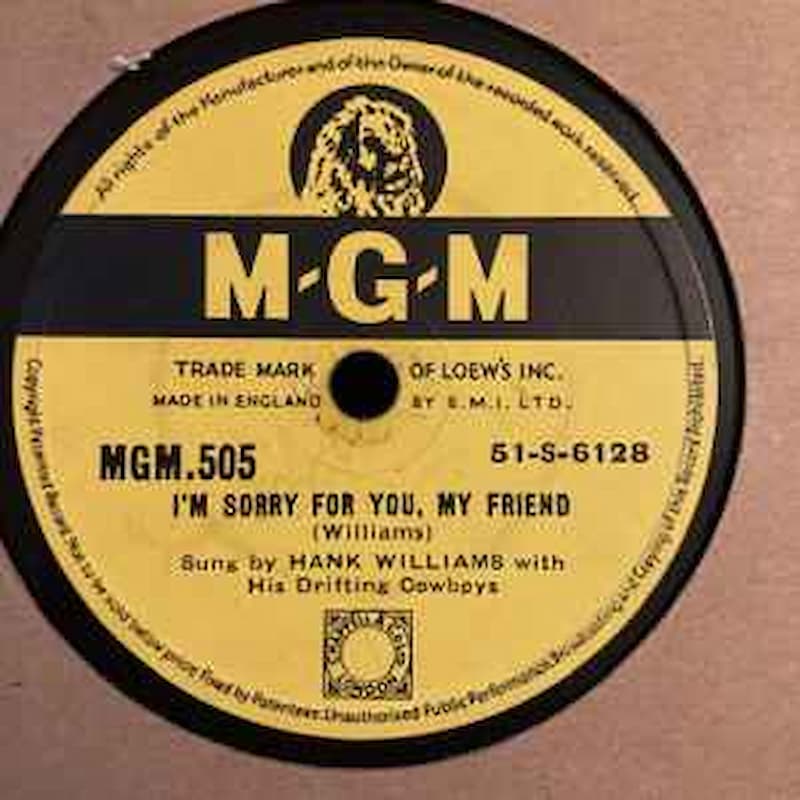
About The Song
There’s a kind of plainspoken sorrow in “I’m Sorry For You My Friend” that reads like a note slid across a barroom table: immediate, unadorned and full of small truths. Hank Williams had a knack for turning what looked like casual conversation into something that sounded inevitable when sung. This song is one of those moments where the performance feels less like entertainment and more like a man telling another man what he already suspects but cannot bring himself to say out loud.
Stories from the road suggest the song grew out of nights full of confidences. Hank spent so much time in small towns and late-night rooms that people trusted him with things they wouldn’t tell their pastors. Musicians and bartenders who knew the circuit remember Hank listening more than talking; he collected fragments — a phrase, a regret, a weary laugh — and later folded them into a song. That background gives the track its conversational honesty: you feel the presence of other people in the lines, even if they never appear directly.
The recording feels like a private conversation because Hank never tried to dress the sentiment up. He preferred the direct approach — a voice, a guitar, maybe a spare fiddle — so the words land like facts rather than declarations. People who worked with him said he cared about the truth of a line more than the polish of a take. If the moment felt right, he kept it; if it didn’t, he moved on. That impatience with artifice is one reason the song still sounds like something you might overhear in the middle of the night.
There’s also a kindness in the way the narrator addresses the other person. This isn’t the brazen, chest-thumping bravado of many country tunes; it’s sympathy without condescension. Hank’s voice makes the admission gentle. Friends recalled him as both a teller of hard truths and a man who could soften the blow with a joke. That duality — bluntness tempered by compassion — is what gives this song its moral weight: it refuses to make the listener a villain, even as it names failure.
Onstage, the effect was often more powerful than in the studio. Audiences who saw him live talk about the way the room went quiet when he sang tracks like this — not out of reverence alone, but because the words cut close to ordinary life. In those moments the public and private overlap: you hear a personal story and find it reflected in your own. That shared recognition is part of why the song has lingered for listeners who return to Hank’s records looking for realness instead of spectacle.
Over the decades the track has been rediscovered by generations who did not live Hank’s era but who understand the ache of small losses. It’s not a dramatic ballad about ruined lives; it’s the quieter ledger of wear and carelessness. That makes it useful as an evening song, one to put on when you want a reminder that sorrow sometimes arrives as a steady drip rather than a sudden flood.
Ultimately, “I’m Sorry For You My Friend” feels like an act of companionship. Hank offers understanding more than judgment, and that quality — the willingness to sit with another person’s failure without making it a spectacle — is the song’s hardest-earned virtue. It’s the kind of country record that doesn’t demand applause; it asks only to be heard, and the truth of that request is what keeps people coming back.
Video
Lyric
You’ve known so long that you were wrong
But still you had your way
You told her lies and alibis
And hurt her more each day
But now your conscience bothers you
You’ve reached your journey’s end
You’re asking me for sympathy
I’m sorry for you, my friend
You laughed inside each time she cried
You tried to make her blue
She tagged along through right and wrong
Because she worshipped you
You know that you’re the one to blame
There’s no use to pretend
Today’s the day you start to pay
I’m sorry for you, my friend
Today, as she walked arm in arm
At someone else’s side
It made you stop and realize
That time has turned the tide
You should have known you’d be alone
‘Cause cheaters never win
You tried and lost, now pay the cost
I’m sorry for you, my friend