About The Song
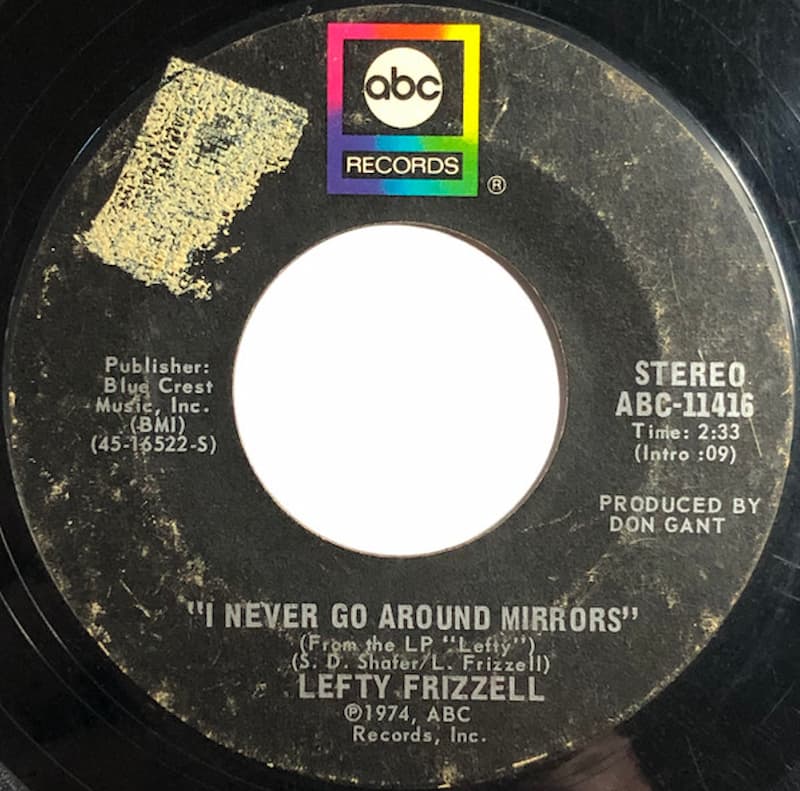
In the summer of 1973 Lefty Frizzell entered Woodland Sound Studio in Nashville for sessions that would mark some of the finest recordings of his later career. On July 17 he cut “I Never Go Around Mirrors,” a track he co-wrote with Sanger D. “Whitey” Shafer. Produced by Don Gant for ABC Records, the song appeared on the album *The Legendary Lefty Frizzell*, released in September 1973. It was issued as a single in early 1974 and became one of the standout performances from Frizzell’s final productive period before his death in 1975 at age forty-seven.
The song was written during the same fertile songwriting trip that produced “That’s the Way Love Goes.” Frizzell and Shafer had driven to Dallas Frazier’s cabin outside Nashville, trading ideas on the road. Shafer started a melody and Frizzell responded with the title line. The two men finished both songs that afternoon. By evening Frizzell had already performed the new piece at an informal guitar pull, where it left a strong impression on everyone present, including Johnny Rodriguez and Merle Haggard.
At its core the ballad is a raw, unflinching look at heartbreak and self-reflection. The narrator admits he cannot bear to face his own image because the mirror shows a man worn down by lost love, regret, and the passage of time. Lines such as “I can’t stand to see / A man look back at me / Who’s aged so much since yesterday” capture the quiet devastation of someone trying to hide from the visible evidence of emotional damage. Frizzell’s voice, now deeper and richer with experience, delivers the confession with the same smooth slides and conversational phrasing that defined his style for more than two decades.
The single reached number twenty-five on the Billboard country chart in the spring of 1974 and spent several weeks on the national survey. Although it was not a blockbuster hit like his early-1950s smashes, the track earned immediate respect among musicians and fans. It appeared on *The Legendary Lefty Frizzell* alongside other strong cuts from the same sessions, proving that Frizzell’s storytelling gift had only grown sharper with age.
Over the following years the song became one of the most recorded and admired pieces from Frizzell’s catalog. Merle Haggard cut a version in 1976, Willie Nelson followed in 1977, and Keith Whitley recorded what many consider the definitive cover in 1988. Whitley even worked with Shafer to add an extra verse that deepened the song’s emotional impact. David Frizzell and others have also kept the track alive in family tributes and live performances.
By the time “I Never Go Around Mirrors” was released, Lefty had already lived through the whirlwind of early fame, personal struggles, and a late-career renaissance with ABC. The song’s disillusioned tone has often been seen as partly autobiographical, reflecting the hard-won perspective of a man who had experienced both triumph and loss. Its inclusion on later compilations and its frequent ranking among country music’s greatest heartbreak ballads underscore its lasting power.
More than fifty years after it was recorded, “I Never Go Around Mirrors” stands as one of Lefty Frizzell’s most enduring late-period masterpieces. What began as a casual songwriting exchange on a country road became a timeless meditation on regret, aging, and the courage required to face oneself. The record remains a cornerstone of his legacy and a favorite among classic country listeners who value honesty over flash.
Video
Lyric
I can’t stand to see a good man go to the waste
One who never combs his hair or shaves his face
A man who leans on wine over love that’s told a lie
It tears me up to see a grown man cry
I never go around mirrors
I can’t stand to see me without you by my side
I never go around mirrors
‘Cause I’ve got a heartache to hide
I never go around mirrors
I can’t stand to see me without you by my side
I never go around mirrors
‘Cause I’ve got a heartache to hide
And it tears me up to see a grown man cry